A better AI score does not prove the model improved
A higher AI evaluation score may reflect a better product or a different measuring instrument. Use this practical baseline method before approving a model upgrade.
Read articleInsights on compliance, certification and AI governance from the trenches.

A higher AI evaluation score may reflect a better product or a different measuring instrument. Use this practical baseline method before approving a model upgrade.
Read article

Before shipping an AI update, check more than the quality of its answers. These five practical checks help growing SaaS teams assess task outcomes, permissions, human handovers and regressions which make a better informed release decision.
Read more: Before you ship an AI update: five checks for growing SaaS teams
The debate over slowing frontier AI won’t answer your next customer review. Your business still needs evidence of what its AI can access, do and change.
Read more: The AI slowdown lawsuit: your customers still need proof
Compliance software can collect evidence, monitor controls and draft questionnaires. But someone still has to own the programme. Here’s why growing AI and technology companies need more than another compliance platform.
Read more: Compliance software is not a compliance function
Human in the loop has become the default answer to every hard question about AI safety. But most oversight today is theatre. The difference between oversight that works and oversight that doesn't is a design decision, not a policy one.
Read more: Human oversight is not a policy. It's a design problem.
Don’t start AI governance from zero. If you have ISO 27001, you are already 30-40% of the way to ISO 42001 certification. This guide breaks down exactly how to integrate the two standards to avoid audit fatigue, the specific evidence you still need to generate, and a 120-day roadmap to get you certified.
Read more: Building AI governance on your existing security foundation
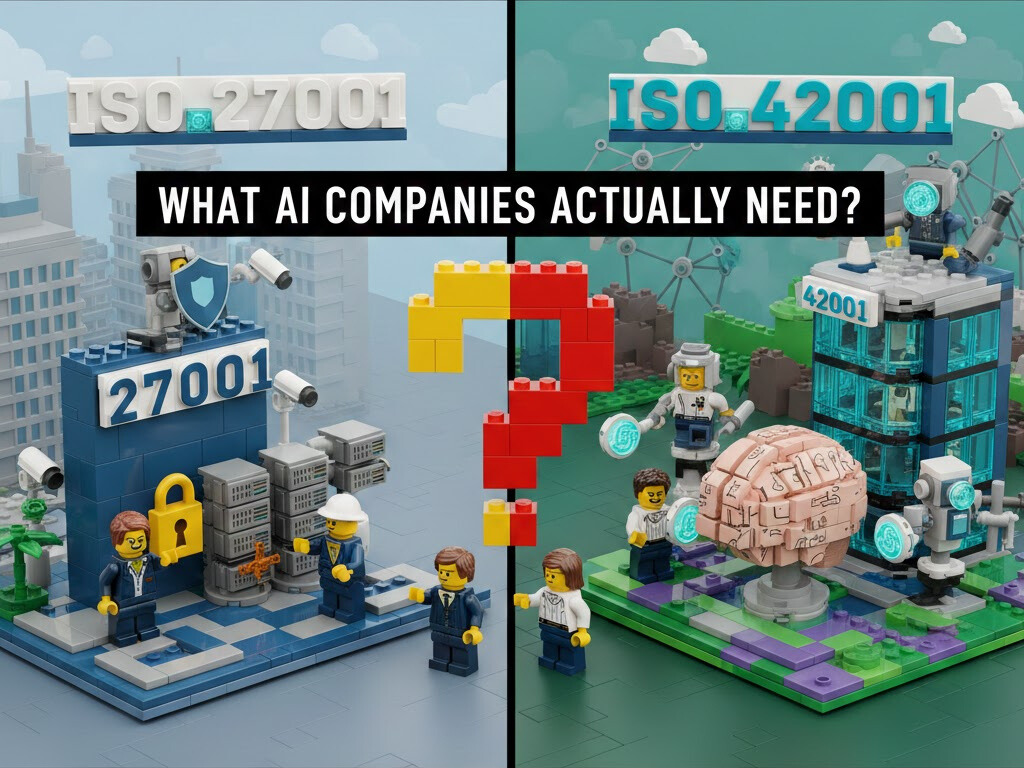
ISO 42001 used to be optional. That's changing fast. Microsoft's SSPA program now includes it. Enterprise RFPs are asking for it. With EU AI Act high-risk compliance due August 2026, here's how to sequence your certifications without blowing your budget.
Read more: ISO 27001 vs ISO 42001: What AI companies actually need
A new business category is reshaping how companies access AI capabilities. AITool-as-a-Service (AITaaS) isn't about selling software subscriptions or consulting hours, it's about mastering AI tools and selling outcomes directly to businesses. The economics are staggering: AI tools cost $10-100 per month, whilst services built on those tools command $500-5,000 monthly or more. This arbitrage creates margins between 60-95%, enabling solo operators to generate seven-figure annual revenues and small agencies to scale without proportional headcount increases. This isn't theory. One designer at Designjoy generates $1.2-1.74 million annually through AI-powered design services. Freelancers buying ElevenLabs for $5/month charge $10-60 per voiceover project, creating 90%+ margins. Marketing agencies using AI are cutting costs 70% whilst doubling delivery speed. Yet most service providers haven't realised this opportunity exists. They're still thinking linearly: more clients = more staff. AITaaS inverts that equation: AI handles 70-90% of production work, humans provide strategy and quality control, and the result is exponential scaling with minimal overhead.
Read more: The AITool-as-a-Service opportunity: How $10-100/month tools generate $500-5,000 monthly revenue
Here's the uncomfortable truth: less than 1% of companies have operationalised responsible AI, while trust in AI continues to fall. The gap isn't about awareness. It's about approach. Most organisations treat AI compliance as a legal problem and hiring consultants to write governance frameworks and hoping documentation satisfies regulators. But the EU AI Act requires something different: technical systems built for transparency, auditability, and accountability. This is where compliance-as-code comes in. Just as DevSecOps transformed security from policies to automated enforcement in CI/CD pipelines, compliance-as-code treats AI governance as infrastructure. Risk classification becomes a function in your model registry. Bias detection becomes a test. Audit logs become automated. This article explains why traditional compliance approaches fail for AI, how to map EU AI Act requirements to technical architecture, and a week-by-week playbook for CTOs and engineering leaders to implement compliance-as-code without sacrificing velocity. The startups that figure this out will move faster and build more trust.
Read more: Why compliance-as-code will separate AI leaders from the rest
Fundraising in 2025 presents a paradox: capital has returned, but competition has intensified. Q3 2025 saw $97 billion in global funding, up 38% year-over-year. Yet 46% went to AI companies, deal counts declined across most stages, and only 20 to 36% of seed-stage startups are graduating to Series A, compared to historical rates of 51 to 61%. More capital is flowing, but to fewer, stronger companies. A fractional CTO provides the competitive edge startups need in this selective environment. With 97% of investors now intensely scrutinising cybersecurity and technical capabilities during due diligence, fractional CTOs help startups survive technical review, win enterprise customers, and demonstrate the execution capability that separates the 20% who graduate from the 80% who don't.
Read more: Investor-ready tech: How a fractional CTO boosts fundraising success
ISO/IEC 42001 (AIMS) gives startups a practical, auditable framework to manage AI risk, transparency and continual improvement. For Australian startups, especially those aiming at international customers, getting the basics right now reduces regulatory friction, builds trust with customers and investors, and avoids expensive rework later. A virtual compliance officer can deliver that governance fast, pragmatically and without the overhead of a full-time hire.
Read more: Implementing ISO 42001: AI governance for your startup
Non-technical founders often struggle to translate their vision into a practical tech plan. Discover how partnering with a Complyd fractional CTO creates a clear, low-risk roadmap that accelerates product development, avoids hidden tech debt, and ensures early compliance with AI governance standards
Read more: Crafting your tech roadmap: A non-technical founder’s guide
Read about the 2025 R&D Tax Incentive form changes, evidence preparation and registration deadlines, with a link to current Australian Government guidance.
Read more: New R&D registration form launched August 15, 2025: What you need to know
Learn why Joe Zhou founded Complyd and how experience building technology companies shaped its approach to compliance, AI governance and enterprise trust.
Read more: The story behind Complyd: From startup CTO to AI compliance pioneer